
Whose “Will” is it Anyway?
In a World of Competing Wills, Only One Leads to Life


For many people, recent weeks have felt like waking up in the matrix. As we watch the news, scroll social media, or overhear conversations, we think, “This can’t be real life.”
Not only are the circumstances themselves shocking, but the responses we see from other “Christians” are disorienting.
Ephesians 4:2-6 (NIV):
“Be completely humble and gentle; be patient, bearing with one another in love. Make every effort to keep the unity of the Spirit through the bond of peace. There is one body and one Spirit, just as you were called to one hope when you were called; one Lord, one faith, one baptism; one God and Father of all, who is over all and through all and in all.
If there is one body and one Spirit uniting all Christians, how can our responses to the same events be so radically different? So different that it makes one question, “Are we one body?”
How can the genocide in Gaza elicit cries for justice for Palestinians, while others continue to support Israeli government aggression?
How can the immigration crisis in the U.S. inspire calls for humane treatment, and simultaneously, rhetoric and action that dehumanize those seeking refuge?
How can the murder of a public figure spark shouts of “revival” and “martyrdom” on one hand, and on the other, an honest reckoning with the totality of their public life and their impact on marginalized communities?
These aren’t minor disagreements—they’re life-and-death issues, and the responses are poles apart. How can this be one body as described in Scripture?
The answer is not to demand uniformity of opinion. Let us not conflate uniformity with unity. Scripture calls for unity—rooted in humility, patience, and love. Most importantly, for unity in the body, our thoughts, actions, and words must align with God’s will. If our responses are this fractured and far apart, we might not be guided by the same source.
Romans 12:2 says, “Do not conform to the pattern of this world, but be transformed by the renewing of your mind. Then you will be able to test and approve what God’s will is—his good, pleasing and perfect will.”
This verse offers a key: discernment of will.
What is the Will?
The will is the inner faculty by which we consciously choose, direct, and control our actions.
Drawing from multiple definitions, the will consists of choices, desires, purposes, carrying out those purposes, and attitudes toward others.
What do these definitions mean for the Christian?
It means the will is more than just our choices or preferences. It is the heart of intent and direction deep within us—the place where our decisions are born and transform from thoughts into actions.
If the will is the deep seat of intent and direction within us, then we must ask: what voices shape that intent? What forces tug at that direction?
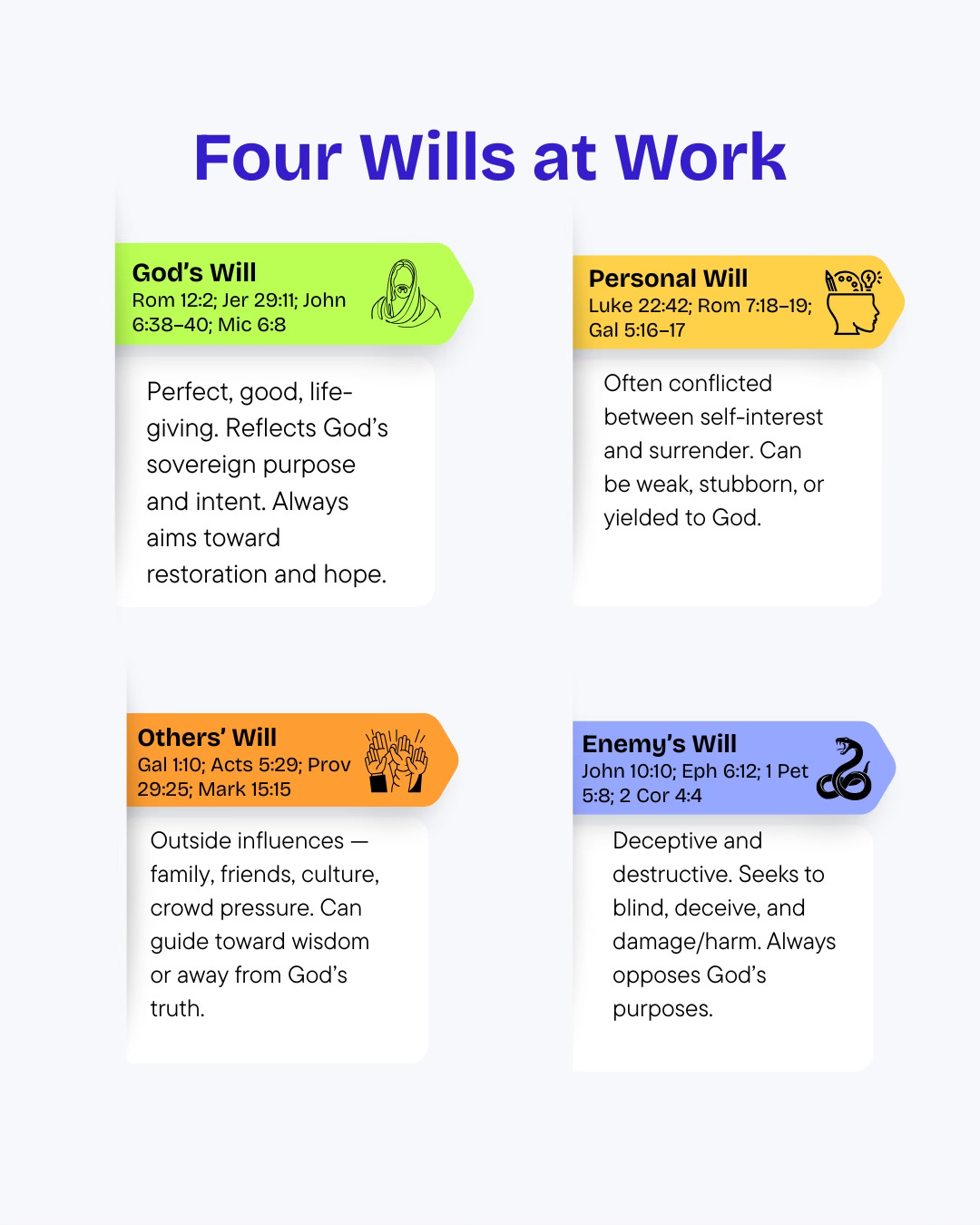
Scripture shows that God’s will is not the only will at work. At least four wills are competing to shape us. If we don’t name them, we risk being formed by them without even realizing it.
The Four Wills
1. God’s will—is good, perfect, and sovereign. He intends to lead toward life, hope, restoration, and flourishing.
2. Our will—is legitimate, but it’s limited and often conflicted, shifting from self-directed to surrendered.
3. Enemy’s will—is distorted and evil, seeking to steal, kill, and destroy.
4. Others’ will—is influenced by our communities, culture, and crowds.
Look at Jesus
As followers of Jesus, we look to Him as our standard and practice His way of being. Jesus himself encountered each of these wills and shows us how to discern, act, and align accordingly.
When it came to God’s will, Jesus and the Father are one. Throughout the Gospel of John, we see Jesus naming and aligning with God’s will: “My food is to do the will of him who sent me and to finish his work”;1 “I and the Father are one.”2 Jesus’ life exemplified complete unity with the Father’s purposes.
When it came to His personal will, Jesus wrestled and submitted in the garden of Gethsemane. He prayed, “My Father, if it be possible, let this cup pass from me.”3 Jesus desired to avoid this path of suffering and death. Yet, Jesus continued, “nevertheless, not as I will, but as you will.”4 In that moment, Jesus modeled surrender—choosing His Father’s will over His own preference.
When it came to others’ will, Jesus showed us how to discern and rightly choose between voices.
After Jesus explained to the disciples that He must suffer and die, Peter “rebuked” Him: “‘Far be it from you, Lord! This shall never happen to you.’”5 Out of love and loyalty, Peter tried to turn Jesus from the path to the cross.
But Jesus did not bend to the will of others, not even a well-meaning friend. Instead, Jesus replied, “Get behind me, Satan! You are a hindrance to me. You are not setting your mind on the things of God, but on the things of man.”6
In other words, Jesus identified the difference between God’s will and others’ will, and He refused to let another’s voice pull Him away from obedience.
When it came to the enemy’s will, Jesus demonstrated standing firm and resisting.
Before Jesus started His public ministry, the enemy tempted Him in the wilderness with physical needs, power, and testing God.7 Each time, Jesus resisted the enemy with Scripture, and not only as head knowledge, but as the living Word guiding His life.
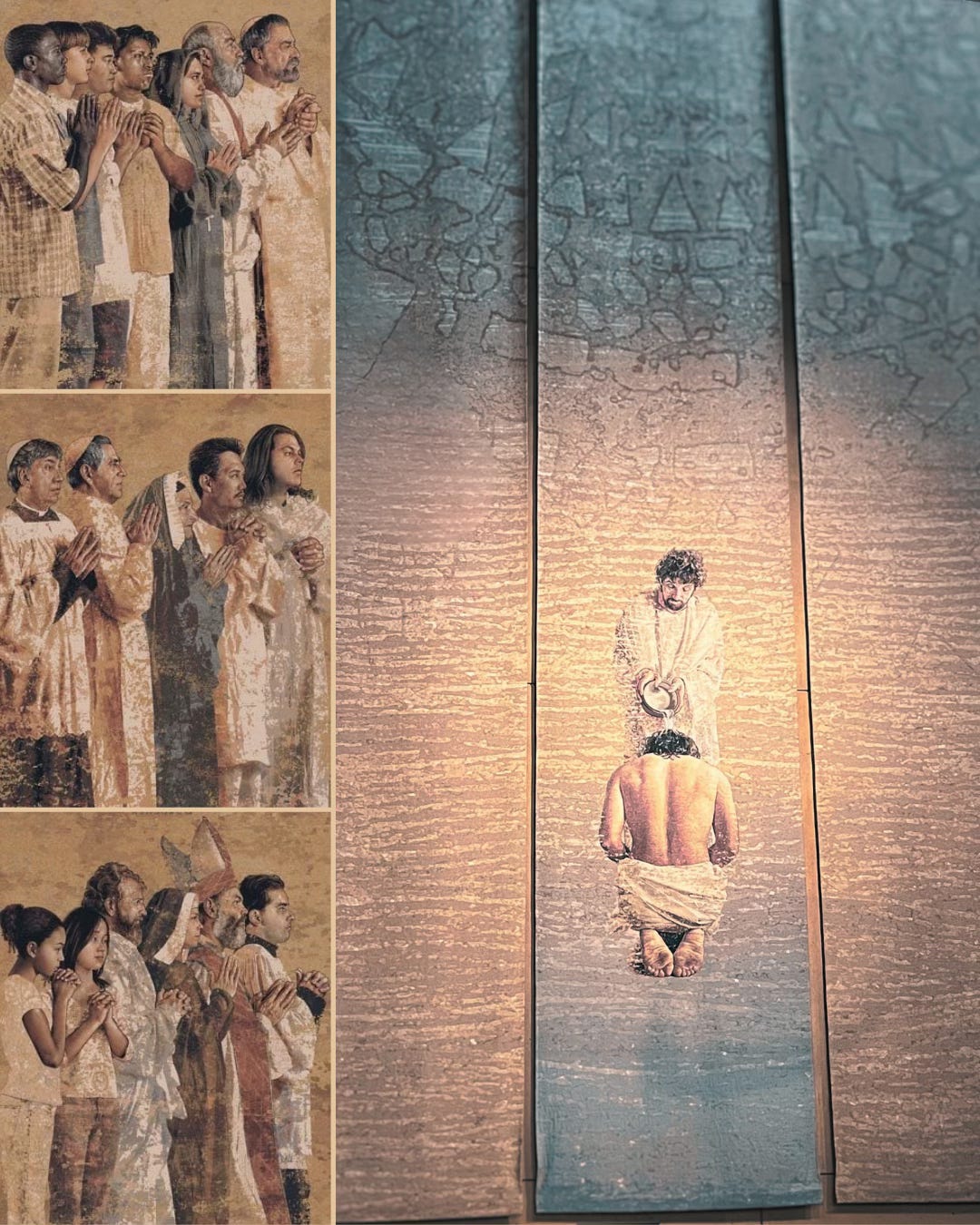
In all these situations, Jesus shows us that discernment isn’t passive—it’s an active process that names the competing will, resists its pull, and chooses alignment with the Father.
Jesus is our example, and by His Spirit we, too, can align with the Father’s will. Remember, the world is watching as we respond to life and world events. Let us walk with integrity that reflects God’s heart and live as Jesus declared us to be: the salt and the light of the world.
Challenge
Choose one of the Gospels (Matthew, Mark, Luke, or John). As you read, reflect on Jesus’ life—His words, His actions, His teachings, and His character. Let His life be our guide.
As you read, ask:
What do Jesus’ words reveal about His priorities (e.g., forgiveness, truth, justice, love)?
What themes or commands appear again and again in Jesus’ teachings (e.g., love, humility, generosity)?
How did Jesus act toward the poor, sick, outcast, or marginalized?
How did Jesus embody love, justice, compassion, and truth in His daily interactions?
If someone were to observe my responses to today’s world events, would they see the character of Christ in my life?
John 4:34, CSB.
John 10:30, CSB.
Matthew 26:39, ESV.
Matthew 26:39, ESV.
Matthew 16:22, ESV.
Matthew 16:23, ESV.
Matthew 4:1–11; Luke 4:1–13.
Thank you well said as Christian’s having the same father we should be united in what God says over anyone else including what we think. He has the last word. Jesus tells us how to act. Micah 6-8